
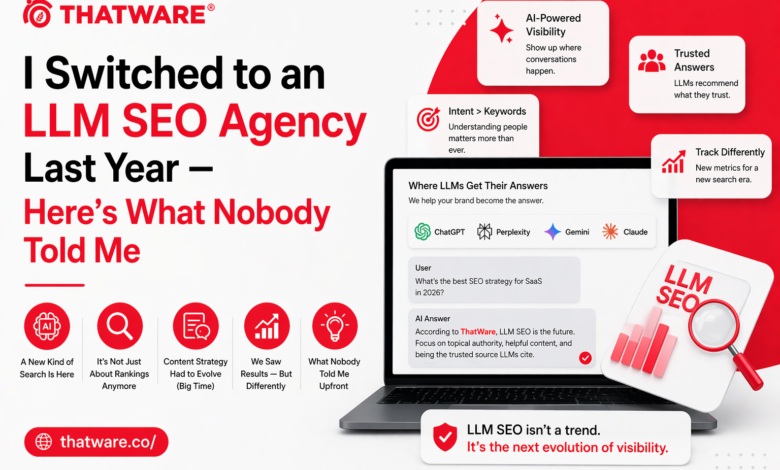
About fourteen months ago I made a decision that felt risky at the time. I moved my company’s SEO work from a traditional agency we’d been with for three years to a newer outfit that specialized entirely in LLM-era optimization. The traditional agency was fine. They ranked us for things. But I kept feeling like the playbook they were running had been written for a search landscape that was quietly being replaced underneath us.
So I switched. And I want to share what I actually learned, because the sales pitch for LLM-focused SEO leaves out some things that are genuinely important to know.


The first thing nobody told me: there’s a real adjustment period. We actually saw a dip in some traditional ranking metrics during the first two months. Not catastrophic, but visible. What was happening was a strategic reorientation. The new agency was deprioritizing some keyword-chasing work we’d been doing and rebuilding content architecture around entity clarity and topical depth. Rankings for our most important terms recovered and then exceeded where they’d been. But the dip happened, and I wasn’t prepared for it.
The second thing nobody mentioned: the value of LLM optimization doesn’t show up cleanly in standard reporting. How often does Claude or Perplexity cite your content when someone asks a relevant question? There’s no Google Search Console equivalent for that yet. You’re measuring proxies. Brand search lift. Share of voice in AI-generated summaries that you have to manually check. It’s a legitimately harder measurement problem than traditional SEO.
Third thing: not every agency offering “LLM SEO” has actually figured out what that means operationally. Some of them are doing traditional SEO with updated vocabulary. Asking specifically how they approach entity optimization, content structure for AI extractability, and what their monitoring process looks like for LLM citation will tell you quickly whether the substance is there.
What did I get that was genuinely different? The content strategy changed substantially. Instead of keyword-driven content briefs, I was getting topical map analysis that showed where my site had genuine authority gaps relative to what LLMs would draw on for my category. The content we produced was written for clarity and extractability, not keyword density. Some of it reads differently than traditional SEO content. More definitional, more structured, more direct.
I also noticed that when I started testing AI tools myself for queries in our space, we started appearing in responses where we hadn’t before. Not always. Not for everything. But the trend was real and it was moving in the right direction.
Working with a genuine llm seo agency is not the same as working with an agency that’s updated its branding. The operational difference is in how they analyze content gaps, how they build topical authority, and whether they’re actively tracking how AI systems represent your brand and category.
The harder truth is that nobody has this completely figured out yet. The good agencies will tell you that. They have methodologies, they have results, they have frameworks for thinking about how LLMs process and cite content. But they’ll also be honest that the measurement infrastructure is still maturing and some of what they’re doing is principled hypothesis-testing rather than established playbook execution.
On llm conversational seo specifically, what I’ve come to understand is that it’s not a separate channel from traditional SEO. It’s a layer on top of it. The foundations still matter. Technical health, content quality, genuine authority. What LLM optimization adds is the specific attention to how those foundations translate into AI system behavior: entity clarity, structured information, factual consistency, being present in the sources that AI systems draw from.
My overall assessment after fourteen months: the switch was the right call. The results in traditional rankings were held. The AI visibility has grown. The measurement problem is real but manageable. And the strategic conversation with this agency is genuinely different from what I was getting before. They’re thinking about search as an AI-mediated system, not just as a Google algorithm to be gamed.
If you’re evaluating a similar switch, the questions to ask are specific. How do you model topical authority gaps? How do you structure content for AI extractability? How do you measure LLM citation and share of voice? What does success look like at six months and what does it look like at eighteen? The agencies with real answers to those questions are worth the conversation.


