Marc Newson: The Definitive Guide to the Designer Who Shaped Our Modern World


Marc Newson In the vast landscape of contemporary design, few names carry the weight, curiosity, and universal recognition of Marc Newson. He is a figure who transcends the traditional boundaries of his discipline, operating not just as a designer but as a global cultural force. His work is instantly recognizable a fluid, biomorphic, futuristic language rendered in materials that push the very limits of possibility. To speak of Marc Newson is to speak of an aesthetic era defined by seamless curves, a fascination with technology and travel, and an unwavering belief in the emotional power of objects.
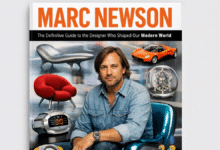

His journey, from a small workshop in Sydney to the upper echelons of the art market and the secretive labs of technology giants, is a masterclass in creative evolution and commercial acumen. This comprehensive guide delves deep into the man, his methodology, his most seminal works, and the profound impact he has had on how we perceive everything from a humble watch to a spacecraft, cementing his authority as one of the most significant and influential designers of our time.
Early Life and the Forging of a Vision
Marc Newson’s origin story is as unique as his designs, rooted in a peripatetic childhood that seeded his lifelong obsession with mobility and form. Born in 1963, he spent his early years traversing Europe and Asia with his mother, an experience that embedded a global perspective and a keen sensitivity to different cultural aesthetics. This constant movement created a foundational theme in his psyche: the idea of the journey, the capsule, and the portable habitat, themes that would resurface powerfully in his later aerospace and automotive work.
His formal training began at the Sydney College of the Arts, where he initially studied jewelry and sculpture. This background is critical to understanding his approach; he never emerged from a classic industrial design program. Instead, Marc Newson brought a sculptor’s sensitivity to volume and a jeweler’s precision to detail and finish, treating every object, regardless of scale, as a singular piece of crafted art.
The pivotal moment, the spark that ignited his career, occurred in 1986 with the creation of the Lockheed Lounge. Working from a borrowed garage, Newson hand-sculpted this undulating, riveted chaise from sheets of aluminum, creating an object that looked like a piece of a futuristic aircraft that had gently crash-landed in a living room. It was a staggering fusion of Art Deco glamour, retro-futurism, and raw, tactile making.
The Lockheed Lounge did more than launch his name; it established his complete design language in one breathtaking statement. It spoke of travel, of exotic materials, of a seamless, flowing form that appeared both organic and manufactured. This piece demonstrated that Marc Newson was not simply designing furniture; he was world-building, creating artifacts from a parallel, more elegant universe that felt tantalizingly within reach.
The Signature Aesthetic: Biomorphism and Technical Poetry
At the core of the Marc Newson aesthetic is a principle known as biomorphism the use of forms that echo those found in living organisms, often smooth, flowing, and devoid of hard edges or abrupt transitions. His objects rarely have a straight line. Instead, they feature soft curves, pod-like enclosures, and a sense of ergonomic embrace.
This is not mere styling; it’s a philosophical stance on the relationship between human beings and the manufactured environment. A Newson design feels familiar and comforting on a primal level, its forms subconsciously reminiscent of pebbles worn smooth by water or the protective curve of a shell. This biomorphic approach creates a profound emotional connection, transforming cold industrial products into objects of desire and tactile pleasure. It’s a language that speaks of fluidity, continuity, and a harmonious blend of nature and technology.
Complementing this organic form is what can only be described as technical poetry an obsessive, almost alchemical pursuit of material and manufacturing innovation. Marc Newson is renowned for forcing the hand of industry, collaborating with master craftsmen and advanced factories to realize forms that were previously thought impossible to produce. He has worked with deep-sea submarine welders, aerospace composite specialists, and precision glassblowers.
This relentless drive to marry visionary form with extreme technical execution is what elevates his work. The aesthetics are inseparable from the engineering; the seamless curve exists because of a breakthrough in molding or welding. This synergy creates a signature look of effortless, monolithic unity. An object by Marc Newson doesn’t look assembled; it looks as though it was born whole, grown rather than built, a perfect fusion of the natural world’s logic and humankind’s most advanced technical capabilities.
Iconic Furniture: From the Lounge to the Embryo
While his practice has expanded into countless fields, it is in furniture that Marc Newson first cemented his iconic status. His pieces here are more than functional items; they are sculptures for inhabiting, each telling a story of material exploration and formal innovation. The Lockheed Lounge remains the ur-text, but the evolution is fascinating.
The Embryo Chair, designed in 1988, took the biomorphic principle to its literal conclusion, resembling a protective womb with its padded, curving fiberglass shell. It showcased his ability to make rigid materials appear soft and inviting. Then came the Orgone Lounge, a vast, sprawling landscape of a sofa that invited complete immersion, and the playful, colorful Felt Chair, which used pressed fiberglass to create a seemingly soft, draped form from a hard material. These pieces established his furniture not just as design, but as collectible art.
The latter part of his furniture work saw collaborations with premium brands that allowed for even greater technical feats. His work for Cappellini, like the iconic “Wooden Chair,” which twisted and bent laminated wood in unprecedented ways, and his sleek, minimalist tables for Magis, demonstrated his mastery across materials. Perhaps the ultimate statement in this realm is the “Kunstform” series for Gagosian Gallery, where furniture pieces were produced in extremely limited editions,
often from solid blocks of marble or exotic metals, blurring the line between functional design and high art gallery sculpture. These works underscore a key Marc Newson philosophy: that the objects we live with should inspire awe and curiosity, that domestic space can be a gallery of human ingenuity. His furniture collections form a cohesive journey through his evolving ideas about form, comfort, and the very nature of an object’s place in our lives.
Conquering Time: The Watchmaking Revolution
The entry of Marc Newson into the rarefied, tradition-bound world of Swiss watchmaking was nothing short of a revolution. When he began collaborating with Ikepod in the 1990s, the industry was largely dominated by classical, round-cased designs. Newson, with his background in jewelry, saw the wristwatch not just as a timekeeping instrument, but as a miniature sculptural capsule a personal spacecraft for the wrist.
His designs, most famously the large, hemispherical “Megapode” and the flowing, curved-case designs, introduced a bold, biomorphic language that had never been seen in horology. The cases were seamless, the lugs integrated, and the dials often featured his trademark “orbital” patterns, creating a sense of dynamic, celestial movement. He treated the watch as a complete, unified organism, much like his furniture.
This foray reached its apex with his historic collaboration with Apple on the Apple Watch. While Jony Ive was the lead, Newson’s influence as a longtime friend and collaborator on concepts of wearability, materials, and minimalist digital interfaces is widely acknowledged. His deep understanding of how form sits on the body and his experience in micro-engineering were invaluable assets.
Furthermore, his limited-edition timepieces for brands like Jaeger-LeCoultre (the Atmos clock) and his own “Marc Newson” brand have achieved astronomical prices at auction, rivaling those of fine art. In watchmaking, Marc Newson achieved something remarkable: he respected the mechanical soul of the craft while fearlessly reimagining its body, proving that avant-garde design could not only enter but also reshape one of the most conservative luxury fields in the world.
The Sky and Beyond: Aerospace and Automotive Design
If furniture and watches represent Marc Newson’s command of the human scale, then his work in aerospace and automotive design showcases his visionary thinking on a grand, infrastructural level. His fascination with flight and travel is a throughline in his career, finding its ultimate expression in projects that are as much about philosophy as engineering. He has designed private jets for companies like Falcon,
where his interior concepts reimagined the cabin as a serene, continuous space, with furniture and architecture flowing into one another, eliminating the cluttered, segmented feel of traditional aircraft. His Kelpie helicopter concept for Airbus was a radical, almost creature-like redesign of rotorcraft aesthetics. Most notably, his work with SpaceX’s Elon Musk on the interior of the Crew Dragon spacecraft is a prime example of his problem-solving prowess, focusing on intuitive usability, comfort, and a calming environment for astronauts in the extreme context of space travel.
In the automotive world, Marc Newson has applied his unifying lens to both concept and production vehicles. His 1999 Ford 021C concept car was a sensation a city car envisioning a “capsule on wheels” with a symmetric design (identical front and rear), suicide doors, and a minimalist, luminous interior. It was a holistic vision of personal transport. He has also collaborated with Aston Martin on special editions, where his role often involves a “total design” approach, extending beyond the car’s body to the key fob, interior trim, and even accompanying luggage.
For Marc Newson, vehicles are not just machines; they are mobile environments, protective shells for human experience. His designs in this field consistently seek to reduce visual noise, create emotional safety through form, and present a future of travel that is elegant, efficient, and inherently desirable, pushing manufacturers to think of the vehicle as a cohesive experience rather than a collection of parts.

Collaborations with Industry Giants: From Apple to Louis Vuitton
A significant measure of Marc Newson’s unique authority is the caliber of brands that actively seek his collaboration. These partnerships are not mere endorsements; they are deep, strategic alliances where Newson acts as a catalyst for innovation and aesthetic disruption. His long-standing friendship and collaboration with Apple’s former Chief Design Officer, Jony Ive, is the stuff of legend. Together, they worked on numerous Apple products and special projects, sharing a philosophy of radical simplicity, material honesty, and a monolithic, seamless aesthetic.
Newson’s influence is part of the DNA of Apple’s design language during its peak transformative years. He formally joined Apple in 2014, solidifying this partnership and working on everything from the Apple Watch to internal R&D projects, bringing his unique cross-disciplinary perspective to one of the world’s most influential tech companies.
Beyond tech, his work with luxury fashion house Louis Vuitton showcased his ability to translate his aesthetic into the world of personal adornment and travel goods. He co-designed a groundbreaking line of luggage and objects that rethought the travel trunk for the 21st century, incorporating advanced materials and his signature curves. He has also lent his hand to designing champagne bottles for Dom Pérignon, a concept store for Colette, a pen for Montblanc, and even a bicycle for Biomega.
Each collaboration is a testament to his “total design” philosophy; he never simply slaps a style onto a product. Instead, he deconstructs the item’s purpose, history, and manufacturing process, then rebuilds it from the ground up through his unique lens. These projects demonstrate that the Marc Newson effect is a universal solvent, capable of dissolving the conventions of any industry to reveal a more elegant, cohesive, and futuristic core.
The Art World and Record-Breaking Auctions
The journey of Marc Newson from designer to blue-chip artist is a pivotal chapter in the story of contemporary design’s valuation. His work has systematically dismantled the hierarchical barrier that once separated “applied arts” from “fine art.” This transition was strategically curated, notably through his relationship with the Gagosian Gallery, one of the most powerful contemporary art galleries in the world. Presenting his limited-edition furniture and objects in a white-cube gallery context fundamentally reframed them as collectible artistic statements rather than utilitarian products.
Pieces like the “Lockheed Lounge” were no longer discussed solely in terms of design innovation but were analyzed for their cultural commentary, materiality, and place within his artistic oeuvre. This gallery representation was a masterstroke, positioning him alongside painters and sculptors and attracting the attention of serious art collectors.
The market confirmation of this status arrived emphatically at auction. In 2015, his “Lockheed Lounge” from 1986 sold at Phillips for a staggering $3.7 million, shattering the world record for a single design object at auction. This wasn’t an anomaly; his pieces consistently command six- and seven-figure sums. As noted by a senior auction house specialist, “Newson’s work sits at a unique crossroads. It possesses the functional lineage of design, the material innovation of craftsmanship, and the conceptual rigor and rarity of contemporary sculpture.
This trifecta makes it uniquely compelling to both design aficionados and art collectors, creating extraordinary market demand.” This auction performance did more than just inflate prices; it validated a new paradigm. It proved that visionary industrial design, when executed with singular artistic intent and extreme rarity, could be valued with the same financial and cultural weight as a masterpiece of painting, forever altering the landscape for collectible design.
Methodology and Creative Process
Peering into the creative process of Marc Newson reveals a fascinating blend of analog tradition and digital futurism. Contrary to the assumption that his fluid forms are born solely in 3D modeling software, he often begins with the most fundamental of tools: sketching and physical model-making. He is a prolific sketcher, filling countless notebooks with fluid line drawings that explore form, proportion, and connection.
This hand-drawn phase is crucial for capturing the intuitive, organic flow that defines his work. Following this, he frequently moves to physical scale models, sculpting in clay, foam, or wax. This tactile engagement allows him to understand the object in three dimensions, to feel its weight and how light plays across its surfaces. It’s a process rooted in his sculpture training, ensuring that even his most technologically advanced products retain a hand-crafted, sensual quality.
Only after this physical interrogation does the process migrate to the digital realm, where CAD (Computer-Aided Design) software is used to refine the geometry with absolute precision and prepare it for engineering and production. Here, his collaboration with technicians and engineers becomes intense. He is known for being deeply involved in the manufacturing minutiae, often pushing processes to their absolute limits to achieve the seamless finish he demands.
Whether it’s a new technique for bending plywood, a novel application of rotational molding, or a bespoke aluminum casting method, the production itself becomes part of the creative act. This end-to-end involvement from the first sketch to the factory floor ensures that the final object is a pure, undistorted translation of his initial vision. It is a holistic methodology where art, design, and engineering are not sequential steps, but concurrent, interdependent conversations.
Legacy and Influence on Contemporary Design
The legacy of Marc Newson is already deeply embedded in the fabric of contemporary visual culture. His most immediate influence is, of course, aesthetic. The biomorphic, seamless, “blobject” language he pioneered in the late 80s and 90s became the dominant design idiom of the early 21st century, visible in everything from consumer electronics and kitchen appliances to architecture and automotive design.
He demonstrated that technology could be soft, friendly, and organic, a principle that fundamentally shaped how companies like Apple made advanced computing accessible and emotionally resonant. He normalized the idea of the designer as a cross-disciplinary “universal solver,” capable of applying a coherent vision to any scale or product category, from a teaspoon to a jet interior. This has inspired a generation of designers to think beyond their specialization.
On a broader cultural level, Marc Newson’s career has been instrumental in elevating the stature of design itself. His successful navigation between mass production, limited editions, and the fine art market has shown that design is a serious intellectual and commercial discipline. He helped break down the old snobbery that separated the “high” from the “low,” proving that a well-designed chair could be as culturally significant and valuable as a painting.
His collaborations have shown global corporations the immense value of deep, principled design thinking. Furthermore, his focus on emotion, wonder, and storytelling through objects has pushed the entire field beyond mere problem-solving toward creating meaningful experiences. The Marc Newson legacy is not just a catalog of beautiful objects; it is a rewritten rulebook for what a designer can be and what design can achieve in the modern world.
Critical Perspectives and Cultural Impact
While acclaim for Marc Newson is widespread, a nuanced view includes engagement with thoughtful criticism. Some design theorists and historians have occasionally questioned the overarching narrative of his work, suggesting that his powerful, signature style can sometimes feel like an aesthetic overlay applied to disparate objects, a “Newson-ification” that prioritizes a recognizable look over a deeply problem-specific solution.
Critics have pointed out that his most iconic works are often singular sculptures or luxury items, removed from the constraints of mass-market usability and cost. This perspective asks whether his true genius lies in visionary art-making rather than in democratic industrial design that improves everyday life for the many. It’s a debate that touches on the eternal tension in design between artistic expression and utilitarian social mission.
Yet, even within this critique, his immense cultural impact is undeniable. Marc Newson has become a household name in a field where few designers achieve such recognition. His work features prominently in major museum permanent collections, from the MoMA in New York to the Centre Pompidou in Paris and the Victoria and Albert Museum in London, canonizing it for future generations. He has shaped the public’s visual expectation of “the future,” moving it away from the sharp, angular, cyberpunk aesthetic of the 1980s toward a softer, more optimistic, and integrated vision.
Through his collaborations in popular culture like designing a concept guitar for the band Silversun Pickups or a limited-edition sneaker for Nike he has connected high design with street-level cool. Ultimately, his cultural impact lies in making advanced, sophisticated design aspirational and conversational, embedding it into the mainstream cultural dialogue in a way few have managed before or since.
A Comparative Analysis: Newson and His Contemporaries
Placing Marc Newson within the landscape of his peers helps clarify his unique position. The late 20th and early 21st centuries produced several design titans, each with a distinct philosophy. A comparison reveals how Newson carved out his own singular niche.
| Design Visionary | Core Philosophy & Aesthetic | Primary Domains | Key Differentiator vs. Newson |
|---|---|---|---|
| Marc Newson | Biomorphism, Technical Seamlessness, “Future Antique.” Creates emotional, flowing forms through extreme material/process innovation. A holistic, world-building approach. | Furniture, Watches, Aerospace, Automotive, Tech, Luxury Goods. | The universalist, cross-disciplinary “aesthetic pioneer.” Focuses on creating a cohesive, futuristic language across all scales. |
| Jonathan Ive (UK) | Radical Simplicity, Essentialism, Material Honesty. Strip away the non-essential to reveal the pure, intuitive object. Seamless union of hardware and software. | Consumer Electronics, Digital Interfaces. | Deeply focused on the mass-produced digital object and its user experience. Less on artistic sculpture, more on ubiquitous, democratic product ecology. |
| Philippe Starck (France) | Democratic Design, Provocative Narrative. Demystifies design, making it accessible and playful. Often uses humor and surprise to challenge conventions. | Furniture, Hospitality Interiors, Consumer Goods. | The “democratic storyteller.” Prioritizes witty, accessible ideas and volume production over material rarity or technical seamlessness. |
| Ross Lovegrove (UK) | Organic Essentialism, “DNA of Design.” Draws directly from natural structures and morphogenesis. Focus on light-weighting, sustainability, and evolutionary form. | Furniture, Lighting, Consumer Products. | The “natural scientist.” Philosophy is more explicitly driven by biomimicry and ecological efficiency as a core functional principle. |
| Konstantin Grcic (Germany) | Industrial Logic, Geometric Reduction. Pragmatic, analytical approach. Form follows function with a stark, geometric, often architectural precision. | Furniture, Lighting, Industrial Products. | The “industrial pragmatist.” Embraces assembly, modularity, and clear construction over monolithic, seamless forms. |
This table illustrates that while his contemporaries often excel within a specific philosophical or commercial lane, Marc Newson distinguishes himself through his relentless pursuit of a specific aesthetic-sensorial experience (the seamless, fluid, futuristic feel) across an unmatched breadth of fields, coupled with a parallel track in the high-art market.
Conclusion
The story of Marc Newson is the story of modern design’s expanded remit. He is not a designer of things, but a designer of reality a curator of a future that feels both nostalgically familiar and thrillingly new. From the hand-beaten aluminum of the Lockheed Lounge to the sterile, mission-critical interior of a SpaceX capsule, his career is a single, continuous exploration of form, emotion, and possibility. He taught us that a chair can be a landscape, a watch can be a spacecraft, and a jet interior can be a serene sanctuary. More importantly,
he demonstrated that rigorous, artistic design thinking holds immense value for the world’s most advanced technology companies and luxury brands, bridging gaps between craft and industry, art and commerce, the handmade and the mass-produced. As we look around at our smoothed-corner devices, our ergonomic furniture, and our visions of future travel, we are, in many ways, living in a world shaped by the sensibilities of Marc Newson. His ultimate creation is not any single object, but a pervasive aesthetic confidence a belief that our human-made environment can and should inspire wonder, curiosity, and a profound sense of connection.
Frequently Asked Questions (FAQ)
Who is Marc Newson, and why is he so famous?
Marc Newson is an Australian-born, globally renowned industrial designer celebrated for his iconic biomorphic aesthetic, mastery of materials, and unparalleled cross-disciplinary work. He is famous for creating a unified design language of flowing, organic forms applied to everything from the legendary Lockheed Lounge chair to watches for Ikepod, jets for Falcon, and collaborative projects with Apple, making him one of the most influential and recognized designers of his generation.
What is Marc Newson’s design style called?
Marc Newson’s design style is most commonly described as biomorphic, meaning it takes inspiration from organic, flowing forms found in nature. It’s also associated with terms like “retro-futurism” or “streamlined futurism,” characterized by seamless curves, a lack of hard edges, monocoque structures, and a fusion of high-tech materials with a sensuous, almost liquid appearance.
What is Marc Newson’s most expensive piece?
Marc Newson’s most expensive piece sold at auction is the original 1986 “Lockheed Lounge” chaise longue. It set a world record for the most expensive design object ever sold at auction when it achieved $3.7 million at Phillips in New York in 2015. This sale cemented his status at the nexus of high design and fine art.
Where can I see Marc Newson’s work in person?
Marc Newson’s work is held in the permanent collections of many major museums worldwide. Key institutions include the Museum of Modern Art (MoMA) in New York, the Victoria and Albert Museum in London, the Centre Pompidou in Paris, and the Design Museum in London. His limited editions are also featured in high-end design galleries and at international art and design fairs.
Did Marc Newson work for Apple?
Yes, Marc Newson had a formal and significant relationship with Apple. He was a close friend and frequent collaborator of then Chief Design Officer Jony Ive for years before officially joining Apple in 2014 as part of the design team. He worked on special projects, including the Apple Watch, and contributed to the company’s design culture until departing after Ive’s exit in 2019.


